


AI-Powered Web Design in 2025: What’s Next for Designers?

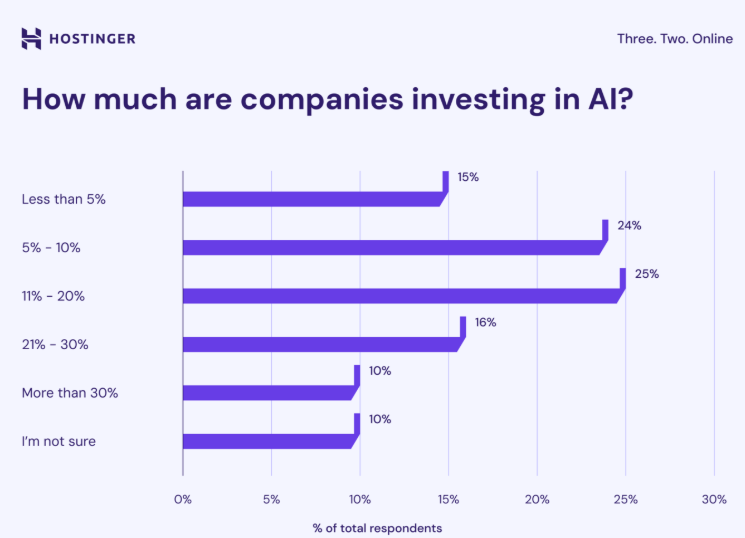
Over the past few years, we’ve seen the rise and adoption of AI in almost every industry, to the point where nearly half of companies are spending up to 20% of their technology projects on adopting, integrating, and training AI models to improve business processes. Web design is no exception. As a professional in the field your most important task this year is to learn and use AI-powered web design.
In this blog post, we will explore the most promising AI advancements in web design so that you can better understand whether or not your job will be replaced by this new technology.
Most Promising AI Advancements in Web Design
According to Hostinger, 55% of web designers say their clients support the use of AI to build their website. A number that is expected to continue to grow as it has proven it can:
- 🎨Generate fully designed websites in minutes based on user preferences.
- 💰Reduce costs by up to 30% over traditional web development by eliminating the need for large design teams.
- 📈Analyse visitor behaviour and adjust content, layouts, and recommendations in real time.
- 📈Analyse search trends and optimise for better rankings.
- 🖼️Adjust font sizes, colour contrast, and screen reader compatibility to ensure compliance.
Using AI Website Builders To Unlock New Possibilities
The rise of AI website builders has made it possible for almost anyone to build a professional looking website. They come with enough features to suggest the perfect template and layout, optimise images, and even personalise content.
For web designers like you, this means more time for what really matters: creating a rich and engaging user experience. But it also means that you need to learn how to use the best AI website builders on the market.
- Framer: Fast AI website builder trained to turn a written prompt into a website in minutes.
- CodeWP: GPT-powered code generator trained to write your site’s code so you can add it to your WordPress site.
- Wix: Effective, easy-to-use AI website builder powered by a chatbot that asks you questions to help you build a great website.
Overcoming Creative Blocks with AI Brainstorming Tools
Factors like your stress level, your energy level, your lack of knowledge, or our fear of failure can quickly drive you into the worst: a creative block during the website creation process. Fortunately, the rise of artificial intelligence can help you overcome it quickly.
Tools like the ones below are trained to help you generate, refine, and organise your site design ideas during a brainstorming session or simply to come up with new concepts and relevant AI generated ideas.
- Miro Assist:An AI tool that starts with a blank whiteboard, and is designed to bounce ideas off an AI chatbot and keep them organised.
- Prompt Board: AI-powered brainstorming tool that generates creative prompts for design projects.
- ChatGPT:Generative AI equipped to answer almost any question you can think of, making room for a real-time brainstorming session.
Delivering Highly Personalised User Experiences
AI-powered tools can analyse large amounts of data (browsing and purchase history, content consumption, etc.) to:
- Learn from user behaviour.
- Create highly personalised websites with an enhanced user experience that suggests content, products, and appropriate experiences for each visitor.
Some of the best AI personalisation solutions we recommend you consider include:
- Insider: Packed with a suite of AI capabilities that allow you to personalise every touchpoint in your customer journey.
- Dynamic Yield: Personalisation platform with a self-training deep learning system that can tailor your site’s digital experience to each user based on their behavior and preferences.
- Monetate: AI platform that allows you to deliver a personalised experience on your website based on personalisation, segmentation and targeting, and audience analytics.
Automating UX, UI, and Content Optimisations
- 👥AI improves the user experienceby analysing user behaviour and optimising interactions in real time. With tools like Hotjar AI, Crazy Egg, and FullStory, you can track user interactions and identify areas of high engagement and pain points.
- 🎨Artificial intelligence simplifies UI design by automatically generating and adapting interface elements. Tools such as Figma AI and Adobe Sensei help by automatically suggesting colour schemes, font pairings, and layouts based on brand identity. They also include features to ensure consistent spacing, alignment, and responsiveness across devices.
- 📝AI also enhances content strategy by improving SEO, personalisation, and engagement. Working with AI tools like Dynamic Yield and Adobe Target, you can analyse user behaviour and deliver personalised content (headlines, images, recommendations). Meanwhile, options like SurferSEO, Clearscope, and RankIQ help you analyse search trends and optimise blog posts, headlines, and meta descriptions for higher rankings.
Is AI Going to Replace Web Designers?
✅The short answer is no. AI-powered web design is not here to replace your job as a web designer.
⚠️However, in order to succeed and grow in the field, it’s imperative that you understand the use and capabilities of AI tools and apply them to your daily work. This will save you time and allow you to focus on what really matters: a personalised and enhanced user experience.
Conclusion
Artificial intelligence will play a larger role in website development, from initial planning and design to content creation and optimisation, streamlining the creative process. It’s up to you to embrace AI-powered design and survive the rapid changes in the field.
Good design doesn’t just come out of a simple prompt, you need to master the use of AI tools and fully understand what user experience and user interface is all about. Click to learn more!


